Part 5: Supporting tamariki and rangatahi during care transitions

What Part 5 of the NCS Regulations requires

Part 5 of the NCS Regulations
(National Care Standards and Related Matters) Regulations 2018 View the full glossary
requires that tamariki
Children (plural) aged 0-13 yearsView the full glossary
and rangatahi
Young person aged 14 – 21 years of ageView the full glossary
are well supported during care transitions. This includes transitions between different care arrangements, returning home after being in care and transitioning out of care into adulthood.

Tamariki and rangatahi must understand why they are moving and receive information about where they are moving to before the transition. An assessment and plan must be completed with them and other important people in their life or those involved in the transition – for example, their whānau
Whānau refers to people who are biologically linked or share whakapapa. For the Monitor’s monitoring purposes, whānau includes parents, whānau members living with tamariki at the point they have come into care View the full glossary
, their current and/or future caregiver or kaimahi at the residence they are moving to.

Tamariki and rangatahi must also receive support based on their unique needs as identified in their assessment, and transition plans must be monitored during the transition.

For rangatahi who are transitioning to adulthood, an assessment of their life skills is required. This assessment considers whether rangatahi have the knowledge and skills they need to live independently and enables support to be put in place if they don’t. The life skills assessment considers practical things like managing money, cooking and driving as well as domains like managing relationships and community support.

Rangatahi transitioning to adulthood must also know about and understand their entitlements once they leave care or custody. For example, rangatahi must be told of their entitlement to receive advice and assistance up until they turn 25.
RANGATAHI

“I was telling my social worker I wasn’t ready to go home. I told my dad I wasn’t ready, and they just chucked me back … At least make it one night and then two days … You don’t just shove [returning kids back home] in there.”

RANGATAHI

“It was shocking. I didn’t know [I was moving], my family didn’t know. They didn’t notify my family, only on the day I was leaving.”

RANGATAHI

“I have a passport and got my driver’s licence with [transition worker’s] help, plus I now have an IRD number and a bank account number. I told them I just want to focus on school for now.”

RANGATAHI

“I’ve got my 18+ card and work kind of licences. When I was doing all those licences, there was a job course with Te Rarawa [and] Tupu. I got to go. I got all those licences from [Tupu]. I got my driver licence from here, Waitomo Papakāinga. I got all my licences from just around here. They’re trying to help me get a full licence.”

RANGATAHI

“You can’t just chuck a kid somewhere and not have them in the plan, it was just weird.”

RANGATAHI

“I practically do it all by myself. Initially, I was in Auckland, in a group home with Reconnect, and I decided to come here so I ran away, packed my bag and came here … I was already with nan, with no approval from Oranga Tamariki.”

RANGATAHI

“I got informed a week or two before [that I was being] moved to my own separate place [then] I got a call the day before, ‘pack up’ and go right then.”

Inadequate planning undermines transitions in care

Similar numbers of tamariki
Children (plural) aged 0-13 yearsView the full glossary
and rangatahi
Young person aged 14 – 21 years of ageView the full glossary
are experiencing a transition in care year on year. More than half of these transitions continue to be unexpected. Where a transition is unexpected, there has usually been limited planning to help prepare tamariki and rangatahi for the transition. We also hear from whānau
Whānau refers to people who are biologically linked or share whakapapa. For the Monitor’s monitoring purposes, whānau includes parents, whānau members living with tamariki at the point they have come into care View the full glossary
and caregivers that they are often not involved in planning for transitions.

Planning for placement changes is vital in providing the right support to tamariki, rangatahi, their whānau and caregivers. Some community providers spoke about extensive transition planning, involving a gradual transition with resources in place to support success.

Abuse and neglect of tamariki and rangatahi returning home has increased

The level of abuse and neglect of tamariki
Children (plural) aged 0-13 yearsView the full glossary
and rangatahi
Young person aged 14 – 21 years of ageView the full glossary
returning home has increased this year. Since we highlighted this significant area of risk in our 2023 Returning Home From Care report,148 Oranga Tamariki has acknowledged that this is an area of focus. It is therefore concerning that so many tamariki and rangatahi are still returning home in an unplanned way and without the help they and their whānau
Whānau refers to people who are biologically linked or share whakapapa. For the Monitor’s monitoring purposes, whānau includes parents, whānau members living with tamariki at the point they have come into care View the full glossary
need to support a successful return home.

Referrals to Transition Support Services are increasing, although some social workers do not understand their role in supporting transition to independence

Positively, the offer rate for the Transition Support Service (TSS) has increased again this year, and rangatahi
Young person aged 14 – 21 years of ageView the full glossary
engaged with the service continue to tell us it is a positive experience. However, in our regional engagements, we heard concerns that some Oranga Tamariki social workers do not understand their role in supporting rangatahi to transition to adulthood. TSS providers told us that this left them to fulfil the role of social workers, which reduced their ability to provide other support to rangatahi.

Transitions in care are common and many are unplanned

Transitions between placements are a relatively common experience for tamariki
Children (plural) aged 0-13 yearsView the full glossary
and rangatahi
Young person aged 14 – 21 years of ageView the full glossary
in care. About one in four tamariki and rangatahi experienced a care transition this year. 

More than a quarter of tamariki and rangatahi experienced a care transition in 2024/25

Oranga Tamariki data: Proportion of tamariki/ rangatahi in care who experienced a transition between placements during the year
2022/23 2023/24 2024/25
25% 25% 28%

Half of care transitions are unexpected

Oranga Tamariki data: Proportion of transitions between placements that were urgent or unexpected
2022/23 2023/24 2024/25
55% 53% 53%

The proportion of planned and urgent or unexpected transitions has remained stable over the past few years, with around half of all transitions being unexpected.149

From our regional engagements, we heard a smaller number within this group experience significant instability.

“I just kept moving out and around.” RANGATAHI 

“[I have had so] many placements since [I was] taken into care at age 6.” RANGATAHI 

“We’ve had kids with 20 to 30 placements. The most was 40 to 60 placements in a lifetime. You can imagine the coping mechanism they needed [to deal with so many placement changes].” KAIMAHI (PROVIDER-RUN) 

Transitions most commonly occur because caregivers are unable or unwilling to continue to care for the tamariki or rangatahi

Care transition reason.150 Percentage of care transitions in 2024/25
Previous caregiver unable/unwilling to continue caring for child 37%
“Formalising” a self-placement by child 14%
Progressing a planned permanent care outcome (living with whānau
Whānau refers to people who are biologically linked or share whakapapa. For the Monitor’s monitoring purposes, whānau includes parents, whānau members living with tamariki at the point they have come into care View the full glossary
, return home etc.)
14%
Behavioural needs of child 13%
Whānau caregivers identified 11%
Parent/previous caregiver demonstrated now able to provide care 10%
High and complex needs of child 10%
Other 9%
Tamaiti (child) abused (or allegation of abuse) in previous care placement 8%

Frequent moves between placements create instability for tamariki and rangatahi

Oranga Tamariki data shows why tamariki and rangatahi changed placements and lists the most common reasons for placement moves during the reporting period. More than a third of tamariki and rangatahi who experienced a care transition this year did so due to a caregiver’s inability or unwillingness to continue to provide care.

Frequent placement moves, whatever the reason, can create instability for tamariki and rangatahi. It can also:

  • disconnect them from education when they change schools
  • disrupt their access to health services
  • weaken their whānau connections.

Transitions in and out of group home care are frequent

For 38 percent of tamariki and rangatahi in a care and protection group home, the length of their most recent stay is less than one month.

Some tamariki and rangatahi who spent time in a care and protection group home during the year have since left care or returned home.

After leaving a group home, 6 percent moved into an interim placement, and data shows an increase in the use of interim placements for this group.

Interim placements are temporary. They include hotels, motels, boarding houses or staying overnight at an Oranga Tamariki site office. The increased use of these placements suggests that tamariki and rangatahi are experiencing continued placement transitions rather than moving into a stable or longer-term placement.

While data shows that individual stays in care and protection groups homes can be short, some tamariki and rangatahi have significant stays. More than a quarter of tamariki and rangatahi spend a total of more than six years in group homes during their time in care. Some tamariki and rangatahi have many moves back and forth between homes.

For those in a youth justice group home, 72 percent were in the home for less than one month for their most recent stay. Most tamariki and rangatahi who spent time in a youth justice group home are no longer in custody. For those who are, it is common to have moved to a placement in a residence.

This pattern of short stays and frequent moves shows how often tamariki and rangatahi cycle in and out of group homes.

Transitions between placements are not always done well

Transitions can often be difficult for tamariki and rangatahi. Good planning, based on timely assessment, is an essential part of social work practice. Many transitions in care occur because circumstances have already deteriorated, often due to a caregiver’s reduced ability to manage behaviours. This makes regular reviews of needs and updates to plans even more important.

When circumstances change, the needs of tamariki and rangatahi must be reassessed and plans must be revised to reflect those changes. Social workers must understand their needs and plan how they will be met for tamariki and rangatahi in their transition.

Planning for most tamariki and rangatahi moving between placements has not changed

Oranga Tamariki data: Sufficient evidence of planning151
For expected transitions
2022/23 2023/24 2024/25
85% 82% 84%
For unexpected/urgent transitions
2022/23 2023/24 2024/25
N/A 57% 51%

Oranga Tamariki data shows that, for the 47 percent of care transitions that were expected, 84 percent of tamariki and rangatahi had “sufficient evidence of transition planning”. For the 53 percent of care transitions that were unexpected or urgent transitions, only 51 percent had “sufficient evidence of transition planning”. Data shows no statistically significant change in how often planning occurred in either expected or unexpected or urgent transitions.

Social workers must also involve tamariki and rangatahi and their whānau in decision making and planning for their transitions in care (regulation 73).

Oranga Tamariki data suggests tamariki, rangatahi and whānau are consulted in around 85 percent of planned transitions and around 70 percent of unplanned transitions. Data also shows no statistically significant change in consultation with tamariki, rangatahi and their whānau whether the transition is expected or unexpected or urgent.

For most transitions, Oranga Tamariki data indicates that it consults with tamariki, rangatahi and whānau

During planning, were the following people consulted?
Child - Expected transitions
2022/23 2023/24 2024/25
91% 90% 81%
Child - Unexpected/urgent transitions
2022/23 2023/24 2024/25
N/A 84% 78%
Whānau - Expected transitions
2022/23 2023/24 2024/25
86% 92% 87%
Whānau - Unexpected/urgent transitions
2022/23 2023/24 2024/25
N/A 76% 66%

What we heard from tamariki and rangatahi in residences and group homes points to a different experience. These experiences reflect more instability, less input and weaker communication.

“It was shocking. I didn’t know, my family didn’t know. They didn’t notify my family, only on the day I was leaving.” RANGATAHI

Oranga Tamariki data also shows that All About Me plans or other plans are not being updated

Oranga Tamariki data: Where there was a care transition, All About Me plan or other plans were updated
Expected transitions
2022/23 2023/24 2024/25
30% 14% 16%
Unexpected/urgent transitions
2022/23 2023/24 2024/25
27% 17% 25%

Oranga Tamariki data looks at evidence that a plan has been updated following a care transition. Data shows that, in most cases, plans are not being updated.

When the plan is not updated, it can significantly undermine the stability and quality of care for tamariki and rangatahi.

Some tamariki do not know about their transition in advance and do not understand why they are moving

In our regional engagements, we mostly heard about transitions between placements from tamariki and rangatahi in group homes and residences. Around one in six of the tamariki and rangatahi we heard from spoke about a recent transition between placements.

Most of them did not know about their transition in advance and did not understand why they were being moved. We heard that, when tamariki and rangatahi move between placements, it happens in a rush and planning is limited.

“I got informed a week or two before [that I was being] moved to my own separate place [then] I got a call the day before, ‘pack up’ and go right then.” RANGATAHI

“You can’t just chuck a kid somewhere and not have them in the plan, it was just weird.” RANGATAHI

“It was sad because they just moved us and didn’t even tell us.” RANGATAHI

Some rangatahi told us they were regularly moved between placements without any reason, notice or time to prepare.

“[I wish Oranga Tamariki had] let me know beforehand. The day before would have been fantastic … [The actual experience was] really awkward, really rushed, trying to jam me in there. It was my first time on my own, in an apartment with windows that face everyone else, everyone else can see, like a fishbowl. [It] was creepy.” RANGATAHI

When tamariki and rangatahi are included in transition planning and informed about changes, they are less stressed and anxious throughout the process. Some rangatahi told us about having a say in where they were going to be placed and having the right information to prepare them for the transition.

“I was meant to be coming in December. My caregiver asked could I stay, talked to Oranga Tamariki and came here in January instead.” RANGATAHI

“Then we had a talk about it and [current caregiver] asked if I wanted to stay full-time, so they did their adult work stuff and it happened.” RANGATAHI

“I just called my social worker when I was at Korowai [Manaaki youth justice residence]. I said can I get transferred ‘cos I don’t like it at Korowai. She told her manager and then I came here.” RANGATAHI

Oranga Tamariki social workers asked some caregivers not to tell tamariki and rangatahi about placement changes

It is concerning that some caregivers were told not to inform tamariki and rangatahi of decisions that had been made about their placements and that they were not told the reason.

“I had to go pick him up from daycare and I had to act like nothing is wrong. I’m holding back the tears. He had been living with us and then I had only an hour to pack his bag and he’s sitting on my knee.” NON-WHĀNAU
Whānau refers to people who are biologically linked or share whakapapa. For the Monitor’s monitoring purposes, whānau includes parents, whānau members living with tamariki at the point they have come into care View the full glossary
CAREGIVER

“He hasn’t been told that he’s out of my care. Oranga Tamariki sold him a different narrative to what the situation really is. They have told him that he will come home, everything will stay the same for him and when he’s finished, he’ll come back to me.” NON-WHĀNAU CAREGIVER

“The attachment is the hardest part. You can’t support these kids and not bond with them and then it gets ripped away. It was hard.” NON-WHĀNAU CAREGIVER

Whānau are not always told when tamariki and rangatahi are being moved from their care placement

The small number of whānau we spoke with about transitions between placements had mixed experiences of being involved in planning for their tamariki and rangatahi. Some whānau members spoke about having knowledge of the transition plan and being able to influence decision making. Others told us they were never informed and did not have an opportunity to share their thoughts.

“I don’t know if supported is the right word, but I was told this is happening, and I was always kept in the loop.” WHĀNAU

“[Youth justice social worker] actually hasn’t told me. She told the judge she had all these people, she didn’t speak about what he was actually going to do.” WHĀNAU

Whānau experiences are different if their tamariki and rangatahi are in care and protection or youth justice custody

The experiences of whānau members varied depending on whether their tamariki and rangatahi were in care and protection or youth justice custody. Some whānau who had rangatahi in youth justice custody told us they were informed about:

  • when their rangatahi would be released from the residence
  • when their next FGC would be
  • where their rangatahi would live following release
  • what kind of release conditions they would have.

Whānau with tamariki and rangatahi in care and protection custody, particularly in group home placements, reported irregular communication and updates to whānau from Oranga Tamariki social workers.

Some whānau shared positive examples of being updated. One whānau member whose tamariki was in a provider-run group home told us they received frequent communication.

“We have daily communication with [Homes of Hope practice lead]. She tells me then and keeps me updated. She’s always emailing me or calling me by phone.” WHĀNAU

Data indicates that, when transitions are planned, caregivers are consulted, although this does not reflect the experience of caregivers we heard from

Transition planning is not being done as often as it should be. However, when it is done prior to transition, Oranga Tamariki data shows caregivers are consulted. Data shows caregivers and residence managers are being consulted before an expected transition 90 percent of the time compared to 81 percent for unexpected transitions.

However, we heard in our regional engagements that caregivers are not included in planning.

“Feels like I’m in the dark. It’s been currently challenging with him getting transitioned out of my care, not knowing what’s happening, or boundaries. It feels like a communication breakdown. This has been happening since the day he came.” CAREGIVER

As noted in Part 1 of this report, caregivers told us they are given little information about the tamariki and rangatahi who come into their care. They also told us little planning is done for this transition. This is despite the requirement for caregivers to be involved in planning and supported to meet the needs of tamariki and rangatahi (regulation 73).

“When we got [child placed in our care], it was a rushed transfer because of the placement she was in.” NON-WHĀNAU CAREGIVER

A couple of caregivers told us the absence of planning extends to transitions of tamariki and rangatahi out of their care. This leads to stress for both the caregivers and tamariki and rangatahi.

“It feels like we don’t have a choice, no time to say goodbye. It’s been a few times. It’s pretty disheartening. [Oranga Tamariki] did not tell us ahead of time, not even an email or phone call to tell us, to communicate.” NON-WHĀNAU CAREGIVER

Group home kaimahi often have little input into transition planning

Most group home kaimahi had little visibility of the planning process as care and protection or youth justice social workers have the lead role in planning transitions between placements.

A group home kaimahi said they were not consulted by social workers on transition plans although they often have helpful information and insights because of the amount of time they spend with tamariki and rangatahi.

“A lot of processes are wrong. Pick [tamariki] up [and] put them anywhere … All of our kids, we’ve never had a say in their transition plan – but we know them the best.” GROUP HOME KAIMAHI (ORANGA TAMARIKI-RUN)

We heard that group home kaimahi sometimes instigate planning, even though it is outside their role.

“We inform [Oranga Tamariki] that we need a pre and post plan before tamariki come into this whare. Otherwise, [tamariki] just come in and sit [in the whare]. But that only happens because we [organised the planning].” GROUP HOME KAIMAHI (ORANGA TAMARIKI-RUN)

Group home kaimahi get little or no notice of tamariki and rangatahi entering or exiting

In general, group home kaimahi said that gradual, planned transition into a group home placement was preferrable. However, kaimahi from both Oranga Tamariki-run and provider-run group homes talked about getting little or no notice of tamariki and rangatahi arriving in and leaving group homes.

This made it difficult for group home kaimahi to prepare other tamariki and rangatahi in the home for the change or to plan and prepare themselves.

“We get the information [that a child is leaving the home] and then we don’t get to farewell them. It feels like we have dumped them … [not even the child always knows they are leaving]. I always think someone at the top [of the management chain] knows they are moving on.” GROUP HOME KAIMAHI (PROVIDER-RUN)

“We get a text, sent the All About Me plan and then they are here. We have no time for preparation. They could be coming in an hour. We have to quickly prepare. It might be a group text. Sometimes the plan comes much later. How do you prep in an hour for a new kid?” GROUP HOME KAIMAHI (PROVIDER-RUN)

Transitions out of group homes also happened with little notice, denying group home kaimahi the opportunity to prepare, reassure or properly farewell tamariki and rangatahi.

“It’s hard sometimes. [Rangatahi] get told they will only be here one night then they’ve been here for like two weeks. They don’t like when the plans change, and they get upset sometimes. In some cases, it can be a while, and then all of a sudden, they’re on a plane tomorrow. Some kids really enjoy it here and they love the routine and then they’re given a last-minute flight and they have to go.” GROUP HOME KAIMAHI (PROVIDER-RUN)

“If Oranga Tamariki staff could tell us about the change and keep open communication, before transition happens, so we know it’s coming, we can better support them.” GROUP HOME LEADERSHIP (PROVIDER-RUN)

Group home kaimahi are not given the information they need for emergency placements

Information sharing was a primary concern for group home kaimahi in relation to emergency placements. Kaimahi gave us examples of receiving All About Me plans that were out of date or lacked important information. They said this limited their ability to help tamariki and rangatahi settle into the group home and to manage their interactions with the other occupants.

“We get referrals from Oranga Tamariki to place children who need emergency care in a transitional period. Trying to get all the required information to make sure we’re accepting the child, but that doesn’t always happen. [Oranga Tamariki] don’t always follow the process. We require an All About Me plan. [This is] the basic information we need. Sometimes we get All About Me plans, but there’s nothing in [the plan]. What are the risks, what is the plan, but it just doesn’t have any information. So I have to create an assessment template to see if they are accepted or not. What are the risks rangatahi come with? Example – we had a rangatahi come to us, it wasn’t made aware to us that this rangatahi was [known to engage in risky behaviour]. When we queried it with the social worker, the social worker said, ‘I don’t know about it’. But the mother had mentioned it to Oranga Tamariki.” GROUP HOME KAIMAHI (PROVIDER-RUN)

One kaimahi from a provider-run group home described an emergency placement into the group home where there were safety issues for a child that Oranga Tamariki did not help them manage.

“One morning social workers and security said it’s emergency placement and dropped [child] off and dropped papers … was here six months. [Child] would run out the door and run in front of buses. Purposely unbuckle seat belt. We had two grown men security for one little [child]. Oranga Tamariki done nothing.” GROUP HOME KAIMAHI (PROVIDER-RUN)

When group home kaimahi are included, it can have positive outcomes

When included in planning for tamariki and rangatahi, group home kaimahi contribute valuable insights and play an important role in shaping plans.

Some kaimahi from specialist group homes told us extensive assessment, planning and consultation take place before tamariki and rangatahi enter the home.

“We don’t offer emergency placements because they don’t work. Placing a young person at 9pm doesn’t work, it isn’t successful. Because we are a therapeutic treatment programme, it won’t work.” GROUP HOME LEADERSHIP (PROVIDER-RUN)

One community provider spoke about a planned transition into its group home. They explained that tamariki and rangatahi who might stay in the home start with a tour of the home before meeting other tamariki and rangatahi. An overnight stay is organised when tamariki and rangatahi feel that the placement option is right for them. It is only after a successful overnight stay that the agency will start the process of transitioning tamariki and rangatahi into the home.

“I think, for me, it’s a staggered transition over a period of time. They would like a quick transition, but this young person could have an [intellectual disability] or be quite anxious. He’s got to engage with the boys, get to know them, it’s the same with the other boys in the whare. It’s all dependent on the young person, sometimes they just want to come in and don’t want to have overnights. It could take a month to transition or could be in a couple months.” GROUP HOME LEADERSHIP (PROVIDER-RUN)

“Transitions are successful because we work at their pace.” GROUP HOME LEADERSHIP (PROVIDER-RUN)

Group home managers can decline placement requests if the home isn’t right for tamariki and rangatahi or if kaimahi don’t have the expertise they need to manage tamariki and rangatahi needs.

“The three of us [group home team leaders and team leader operations] and [placement coordinator] – we have the ability to say no. We know the capabilities of our homes and the group impact assessment is important. We will look at it in depth. I think [national office] take it on board.” GROUP HOME LEADERSHIP (ORANGA TAMARIKI-RUN)

Planning for transitions in and out of residences isn’t consistently completed

When the decision is made to place tamariki or rangatahi in a care and protection residence, tamariki and rangatahi must be given information about the residence and what to expect before they arrive (regulation 67). Tamariki, rangatahi and their whānau or caregivers, social workers and residence kaimahi should all be involved in creating a plan that covers the objectives for tamariki and rangatahi while they are in residence.

The plan must also cover the support and assistance that will be provided to tamariki and rangatahi, their contact arrangements with whānau and how often they will have contact with their social worker.

Pre-admission planning meetings in care and protection residences are an opportunity for information sharing

Care and protection residence kaimahi discussed pre-admission planning meetings between professionals to share information about tamariki and rangatahi needs and the plan to meet them, for example, by coordinating education and mental health services.

“Most times, we have a pre-admission meeting where you get a handover from the [Oranga Tamariki site]. School and nurses are part of that. We get the nitty gritty of things which aren’t written down. If the child is known to [Infant, Child, Adolescent and Family Services] before they get here, we can figure out about the legal side for medication. We can find out what needs to be done for school.”CARE AND PROTECTION RESIDENCE KAIMAHI

However, this did not happen for emergency placements or placements made at the discretion of a judge.

“We also get children in here for [emergency beds] without anything. We only know they’re coming here one hour before they come here.” CARE AND PROTECTION RESIDENCE KAIMAHI

“It depends on where they are coming from. The judge can make a decision that the child will go to [residence] and they just show up.” CARE AND PROTECTION RESIDENCE KAIMAHI

Youth justice planning meetings are not always happening

Oranga Tamariki has different legislative responsibilities for planning with tamariki and rangatahi in youth justice residences, including developing individual care plans,152 specific timeframes for completing All About Me plans153 and additional review requirements for rangatahi who are remanded in a residence.154

Tamariki and rangatahi must also have a plan for their transition out of residence. This plan must be developed by the multi-agency team in the residence and include input from whānau and from other professionals.

In one youth justice residence, some kaimahi said required transition planning meetings “sometimes don’t happen”. Residence kaimahi rely on youth justice social workers’ “good relationships” with rangatahi to make sure they understand what will happen after their release.

“I mean there’s supposed to be a meeting in residence but doesn’t always happen, but then in a middle of sentence, I find that us case leaders have to explain things again. In my experience, young people are okay, but it has to be a good relationship. In that we’re able to help in the sense of good practice, some social workers can be a little difficult. Some others a little tougher, especially what can actually be done or not. I find their plans are quite generic and not realistic. It’s a plan that the boys can’t achieve within a short timeframe. It’s a lack of planning and basic communication.” YOUTH JUSTICE RESIDENCE KAIMAHI

One residence kaimahi said visits from social workers at some Oranga Tamariki sites were infrequent and difficult to arrange, which impacted on transition planning.

Mahuru remand programme is an example of comprehensive planning and transition

Mahuru remand programme is run by Ngāpuhi Iwi
TribeView the full glossary
Social Services

During our regional engagements in Te Tai Tokerau, we heard about the success the Mahuru youth remand service is having with taitamariki Māori (rangatahi
Young person aged 14 – 21 years of ageView the full glossary
Māori).

Mahuru prioritises placement stability

Mahuru is a youth remand service developed and operated by Ngāpuhi Iwi Social Services. The service is for taitamariki Māori of Ngāpuhi descent who are alleged to have committed a serious crime and need to spend time in a safe and stable environment while they await their court hearing.155 The intensive six-week programme intends to support taitamariki, address their offending behaviour, build their confidence and develop their life skills.

Mahuru exemplifies a kaupapa Māori model of care that is taitamariki-centred and whānaubased. Mahuru kaimahi told us “everything is Māori driven in our mahi
WorkView the full glossary
”.

When taitamariki are accepted into Mahuru, they are placed with matua atawhai (caregivers) who can provide a safe home while they are on remand. Strong matua atawhai placements are central to the success of Mahuru. Each taitamariki is placed in a home with a pair of matua atawhai.

Many taitamariki have few positive male role models in their lives, making tāne matua atawhai especially valuable. Matua atawhai provide guidance and stability while helping taitamariki strengthen their cultural identity through shared experiences and whakapapa connections.

“I really enjoy being a caregiver and safety is really important for us. Also their identity is important for them to know where they came from. One of the things they get to do with us is they learn their link, their whakapapa. Their links up here with some of the tamariki
Children (plural) aged 0-13 yearsView the full glossary
, we trace we are actually connected, and when they know that we are connected, they address us as aunty and uncle, and it breaks down the barriers for them. This young fella we had, we found out he was connected to us by my great-great-grandmother, and when we went to go and meet the whānau
Whānau refers to people who are biologically linked or share whakapapa. For the Monitor’s monitoring purposes, whānau includes parents, whānau members living with tamariki at the point they have come into care View the full glossary
and saw how close we were connected, he then felt connected. He had come up from Auckland and he felt part of our family right away. That’s what is important. Some of them don’t have that when they come up. It gives them some kind of foundation here with us.” MATUA ATAWHAI

Taitamariki are at the centre of Mahuru

The programme has a structured admission and welcome process, including a mihi whakatau. The programme also features an end-to-end teina156 plan that is based on the specific goals and needs of taitamariki. The teina plan is taitamariki-led and addresses:

  • culture (including whakapapa and connection to marae)
  • health (including mental health and/or neurodiversity assessment)
  • education (enrolment with Te Kura, support form tutor, NCEA credits)
  • life skills (for example, cooking and budgeting) • skills and recreation (for example, gym, carving or diving)
  • grooming and appearance (for example, haircuts and clothing)
  • whānau connection.

During the programme, taitamariki are immersed in mana
Prestige, authority, control, power, influence, status, spiritual power, charismaView the full glossary
-enhancing activities with Ngāpuhi mentors to develop their identity and pride as young Māori and achieve the goals outlined in their teina plans.

“[Mentors] just try and see what I want to do, not what they want me to do. They are helping me get a job. They are teaching me my background [whakapapa], my Māori history. Teaching me new skills, like gathering kai, learning how to budget your food with our money making. They teach you about keeping yourself tidy, and they like keeping me active.” TAITAMARIKI

“I just know that I’m safe, feel safe, just the way (Mahuru mentors) speak to me, I know I’m safe.” TAITAMARIKI

“I think the whole programme is based on the teina. We have an idea on what the end result should be. It’s a Ngāpuhi-driven programme. We all kind of have an idea on what the values are that we want to put into our teina.” MATURU KAIMAHI

“What we do differently, as I understand it from community homes, is we take them to court and support them in court – whereas in other community homes, the social worker does it. We do doctor/dentist – that stuff as well, we take them to family group conference, we are there for their whole journey.” MATURU KAIMAHI

Taitamariki have a well-planned and gradual transition from Mahuru

Mahuru creates extensive exit plans in addition to teina plans. Exiting from the programme is gradual, and taitamariki are given the tools they need to help the settle back into their community following their placement.

“It’s not just here you are, later, okay let’s go.” MATURU KAIMAHI

“Come up with good plan and take into account whānau visits, transition to home and spending time with whānau again.” MATURU KAIMAHI

Kaimahi from Ngāpuhi Iwi Social Services said their hope was that, by the end of the six-week programme, a decision is made by the court to bail taitamariki to their whānau or supported living placement rather than a youth justice residence or community remand home.

Kaimahi said that, if youth justice social workers have developed a good plan and bail seems likely, mentors will accompany rangatahi to court “cos it’s a positive return to whānau”. If taitamariki were to be moved to residence or community remand, “Oranga Tamariki have to come and pick them up themselves, we don’t want to be part of that transition”.

Return or remain home

The number of tamariki
Children (plural) aged 0-13 yearsView the full glossary
and rangatahi
Young person aged 14 – 21 years of ageView the full glossary
who spent time in return or remain home placements has remained steady over the last three years. Around two-thirds were in return home placements and around one-third in remain home placements in the last reporting period. 

There were 890 tamariki and rangatahi in return or remain home placements in 2024/25

2022/23 2023/24 2024/25
876 889 890

More tamariki and rangatahi are being abused or neglected when they return home

Rates of abuse or neglect increased again this year. There has been an increase in the number of tamariki suspected to have experienced abuse, the number of findings of abuse and the proportion of the return or remain home cohort who have a finding of abuse or neglect.

Tamariki and rangatahi who return or remain home are at an increased risk of abuse. Tamariki and rangatahi often have complex care histories and some are disabled, placing increased pressure on their parents. Unlike other care settings, some tamariki and rangatahi are remaining in or returning to a care arrangement where care and protection concerns have been substantiated.

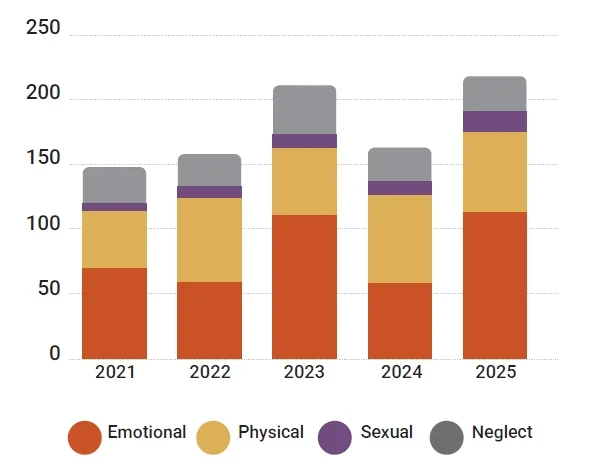
The number of tamariki and rangatahi abused or neglected when returned home has continued to increase

Total children harmed in return or remain placement (12 months to 31 March)
2021 2022 2023 2024 2025
101 96 116 109 134
Findings of harm for children in return or remain placement (12 months to 31 March)
2021 2022 2023 2024 2025
148 158 211 163 218

An increasing proportion of tamariki and rangatahi in return or remain home care are abused or neglected

Proportion of children in return or remain placement with finding of harm (12 months to 31 March)
2024 2025
11% 13%

The increase in findings of abuse in return or remain home placements was driven by an almost 100 percent increase in the number of findings of emotional abuse

Proportion of children in return or remain placement with finding of harm (12 months to 31 March)

Most findings of abuse in return or remain home placements were with parents as the person alleged to have caused abuse (either parent as caregiver or parent not as caregiver). 

Findings from the Oranga Tamariki 2024/25 Safety of Children in Care report157 indicate:

  • emotional abuse was primarily due to tamariki and rangatahi exposure to negative behaviours by parents or other adults in the home, often linked to family violence, substance misuse or mental health difficulties, which reduced the parent’s ability to provide adequate care
  • physical abuse was most commonly experienced by tamariki and rangatahi aged 10 or over
  • physical abuse typically involved slaps to the face or head, punches and kicks to the body, with visible bruising and marks in some case.

Such incidents often arose when parents did not have the skills or support to appropriately manage tamariki and rangatahi behaviour or needs, responding instead with violence.

Since the publication of our 2023 Returning Home From Care report,158 Oranga Tamariki has continued to acknowledge the high risk for tamariki and rangatahi returning home. Despite these ongoing acknowledgements, little has changed in practice.

Most return home transitions are unsuccessful

Not only are tamariki and rangatahi returning home more likely to experience harm, it is also likely that their transition home will be unsuccessful. This means they are removed from the home and experience another transition.

An Oranga Tamariki appropriation measure suggests relatively few tamariki and rangatahi who exit an out-of-home placement subsequently require another out-of-home placement. This is not the case for tamariki/rangatahi who return home. Threequarters (75 percent) of tamariki and rangatahi who spent time in return or remain home placements during the year were removed from home. This is a higher proportion than last year.

A new report of concern was lodged for 36 percent of tamariki and rangatahi who spent time in return or remain home placements during the year. In almost all cases (88 percent) where a new report concern was lodged, tamariki and rangatahi were removed from home.

Tamariki and rangatahi returning home must be visited more

Regular visits to tamariki and rangatahi are crucial following their return home due to the high-risk nature of the placements.

Social work practice has not aligned with policy in recent years, with tamariki and rangatahi who return home being visited less than required.

Just over a third of tamariki and rangatahi who returned home were visited as required

Oranga Tamariki data: Child visited weekly for one month after return home
2022/23 2023/24 2024/25
35% 29% 36%

Even for expected returns home, only 39 percent of tamariki and rangatahi were visited as required for the first month

Oranga Tamariki data: Child visited weekly for at least the first month after returning home – expected return home
2022/23 2023/24 2024/25
35% 39% 39%

Of the tamariki and rangatahi who experienced an expected return home, 39 percent were visited weekly for at least the first month (or to the planned frequency).

Oranga Tamariki case file analysis does not include sufficient numbers of unexpected returns home to determine visit rates with any confidence, and we have not included this data for privacy reasons.

In our 2023 Returning Home From Care report, we highlighted the lack of clear guidance for social workers. In September 2025, Oranga Tamariki updated both its Transitions Within Care Policy and Return Home Policy. Both policies clearly outline the requirement of weekly visits in the first four weeks following a return home.

Recent data from Oranga Tamariki suggests an increase in weekly visits in the final quarter of 2024/25.159 We will monitor whether this shift is sustained over time.

A successful return home requires planning and support

Successful transitions home rely on strong planning and consistent support, yet whānau
Whānau refers to people who are biologically linked or share whakapapa. For the Monitor’s monitoring purposes, whānau includes parents, whānau members living with tamariki at the point they have come into care View the full glossary
are often left without either. The high rate of unsuccessful returns home also shows that more can be done to address the needs of tamariki, rangatahi and their whānau before a return home.

This year, there was little discussion from care and protection social workers about planning or facilitating a return home. Oranga Tamariki kaimahi spoke about tamariki and rangatahi returning home as an aim or purpose but with little specific information about how it was achieved in practice.

Like other transitions in care, we know that transitions home can happen with little preparation and planning. Sometimes this is because tamariki and rangatahi make decisions themselves to return home, although we note that 29 percent of those who returned home in 2024/25 were aged under 10.

“I practically do it all by myself. Initially, I was in Auckland, in a group home with Reconnect, and I decided to come here so I ran away, packed my bag and came here … I was already with nan, with no approval from Oranga Tamariki. They did not approve it. [Oranga Tamariki] eventually approved it.” RANGATAHI

Tamariki, rangatahi and whānau are not getting what they need for a successful return home

For others, the decision to return home is a result of having no other placement options. One rangatahi talked about their journey transitioning from placement to placement after multiple placement breakdowns. Eventually they asked to return home, and this was approved by Oranga Tamariki. However, the process was rushed and unsupportive and did not meet rangatahi needs.

“I was telling my social worker I wasn’t ready to go home. I told my dad I wasn’t ready, and they just chucked me back … At least make it one night and then two days … You don’t just shove them in there. Even if something has gone down, have something or back-up in place so you shouldn’t put [kids] back in a house where they shouldn’t be.” RANGATAHI

One community agency kaimahi told us that timeframes can drive the transition rather than the needs of tamariki, rangatahi and their whānau.

“Some are planned and there are good intentions to work nice and smoothly and yet the dates are set, so if a young person is not ready or whānau are not ready, too bad it’s set.” GROUP HOME KAIMAHI (PROVIDER-RUN)

Gradual and managed returns home can be more successful

Two caregivers told us about their experience of a positive return home. They described being part of the transition and having a role in helping the whānau to support tamariki, based on their experience of providing care.

“We met the family, from that transition, we were communicating stuff that works for us especially around behaviours and felt we are part of the mana
Prestige, authority, control, power, influence, status, spiritual power, charismaView the full glossary
and we connect with the family. We enjoy that process because we feel we are connected with the boys.” NON-WHĀNAU
Whānau refers to people who are biologically linked or share whakapapa. For the Monitor’s monitoring purposes, whānau includes parents, whānau members living with tamariki at the point they have come into care View the full glossary
CAREGIVER

Some group home kaimahi also gave practical examples of assisting tamariki and rangatahi returning home. In contrast to the unplanned entries into group homes, we heard examples of wellplanned, gradual transitions out of group homes.

“[Transition out of the group home] depends on the social worker. Usually what happens is that we have a plan for [a rangatahi]. We will start with Sunday visits that are supervised to a day visit [with whānau] and then to weekends. So it’s like we move to shared care. We do this while working with mum and asking her how she went over the weekend while trying to strengthen those weakness areas so more often than not it works that way. We also set up a poroporoaki (farewell) for them before they leave. We get all the photos, even the embarrassing ones, and then we move it all onto a memory stick for them to take when they go back to their whānau.” GROUP HOME LEADERSHIP (PROVIDER-RUN)

“There are the dinners with whānau that increase. It will end up being one night where the kid stays overnight … It’s always tailored to the needs of the whānau. We’re going to make it four to six weeks of transition.” GROUP HOME KAIMAHI (ORANGA TAMARIKI-RUN)

“Once we get an ‘exit day’, we ensure they have visits with family overnight. We have a sibling group … returned to mum. We got a heads up it was coming up, they were already having two visits with mum a week, so the visit times went longer, then to overnight in the last two weeks, then they would stay three to four days to help the children and their mum get ready to transition home.” GROUP HOME KAIMAHI (PROVIDER-RUN)

Reducing abuse and neglect in return home care is stated as a priority, yet practice is not shifting

Oranga Tamariki has identified abuse and neglect in return home placements as a key target area in its National Care Standards Action Plan this year and has again committed to the need for a greater focus on the safety of tamariki and rangatahi returning home.

Tamariki, rangatahi and their whānau need access to the right assistance in the community. This means ensuring enough capability and capacity within the community agencies that work alongside them and that these services are well resourced.

Parents are often not getting the same level of help that caregivers receive, despite facing equally complex challenges. While Oranga Tamariki policy sets out practice expectations around support for parents, it is not as clear or defined as the support set out by the NCS Regulations
(National Care Standards and Related Matters) Regulations 2018 View the full glossary
for caregivers, nor is there a specialised workforce like CGRS in place.

Until we see improved planning that addresses the needs of tamariki, rangatahi and their whānau and a sustained increase in regular visits, we are unlikely to see a reduction in harm for tamariki and rangatahi returning home.

Transition to adulthood

Like last year, around a third of tamariki and rangatahi who were in care during the reporting year, including in youth justice, are aged 15 or over. Around half of these rangatahi have been in care for five years or more.

Rangatahi are eligible for TSS if they have been in care or youth justice custody160 for over three continuous months from 14 years and 9 months up until they turn 18.

Oranga Tamariki has a legislative requirement to help eligible rangatahi prepare to leave care or youth justice custody. Oranga Tamariki social workers must complete a life skills assessment, referral to a transition worker where there is consent, help rangatahi obtain official documentation161 and lead their transition planning.

Oranga Tamariki must proactively maintain contact with rangatahi after they leave care or custody up to age 21162 and must provide advice and assistance to rangatahi up to age 25. Rangatahi are entitled to support to remain living with or return to a caregiver up to age 21. Oranga Tamariki must also ensure rangatahi understand their entitlements under the transition to adulthood service. 

Two-thirds of tamariki and rangatahi have some planning for their transition but only around one-fifth have a formal plan

When rangatahi transitioning out of care or custody are well supported, they are more likely to experience stability and achieve positive outcomes in their lives.

Tamariki and rangatahi who have been in care or custody are more likely to experience negative life outcomes when compared to their peers who are not known to Oranga Tamariki. Data from the IDI shows young adults aged 18–25 eligible for TSS in 2023 were 10 times more likely to be on a main benefit and 40+ times more likely to have accessed emergency housing than those with no Oranga Tamariki involvement.

With the right care and guidance, they can overcome the unique challenges of leaving care or custody and thrive alongside their peers.

Oranga Tamariki data shows that the number of rangatahi who have a formal transition plan for their transition to adulthood is about the same as in 2023/24. Two-thirds of rangatahi transitioning to adulthood have had some transition planning – but this is more often than not planning activity rather than a formal transition plan.

Planning for transition to adulthood and completion of plans continues to be limited

Oranga Tamariki data: Formal transition plan
2022/23 2023/24 2024/25
N/A 18% 19%
Formal transition plan or planning activity163
2022/23 2023/24 2024/25
48% 68% 66%

Only around half of rangatahi aged 18 who exited custody in the last year had a record of a transition to adulthood FGC or case note that recorded a transition plan.

Oranga Tamariki data also tells us that planning activity is unlikely to be supported by a completed life skills assessment. Oranga Tamariki data suggests164 that only 11 percent of rangatahi transitioning to adulthood have a life skills assessment. A life skills assessment must be completed for eligible rangatahi aged 15 or over (regulation 75).

Life skills assessments are an opportunity for social workers to identify the needs of rangatahi, their strengths and aspirations for the future. The outcome of the life skills assessment informs transition planning and must be recorded in the transition plan.

Oranga Tamariki told us the tool is now embedded in all TSS training and resources, including induction for new social workers. However, completed assessment numbers remain low.

The percentage of eligible rangatahi with a completed life skills assessment is one of the priority areas for Oranga Tamariki in its National Care Standards Action plan. While the tool is described as embedded, the limited training and ongoing low completion numbers suggest it is not yet being treated as a priority.

Life skills assessment numbers continue to fall

Oranga Tamariki data: Life skills assessment completed165
2022/23 2023/24 2024/25
38% 16% 11%

Comprehensive planning helps rangatahi transition well to independence

The importance of comprehensive planning was spoken about by one group home kaimahi who said that, once the social worker let them know the details of the transition, they could focus on helping rangatahi learn life skills that would help them live independently.

“We are more in contact with the social worker, and [they] would make us aware of dates, places and times for the transition. What we were trying to do is raking up more of the life skills like learning how to budget food, how to shop for food and how to use public transport. Showing all these things that before he transitioned out and modelling this is what we do as adults and give him the best basic skills as possible, and I do feel like it did help him. For example, we had a young person who was in care for a really long time, so he needed this. And when he wanted to study, we were preparing him and making sure he knows you have to do things on your own. You wanna prepare them as best as you can.” GROUP HOME KAIMAHI (PROVIDER-RUN)

Two kaimahi from a provider-run group home also spoke about the importance of planning for rangatahi transitioning to adulthood. They said that extensive planning took place between them, Oranga Tamariki and whānau, and in one example, a six-month care extension was arranged to better prepare a rangatahi to transition to adulthood.

“There was a lot of planning with Oranga Tamariki and the HCN hub in preparation for [rangatahi] moving. They agreed for [rangatahi] to stay a further six months after turning 18 [in the group home]. There were services here and other services … to pick up support for [rangatahi]. [Afterwards, rangatahi] stayed in the area. [Rangatahi] has good connections, [Youth One Stop Shop], GP, transition worker and a range of different providers … It was really tough to find good accommodation that will last … [but] two years after leaving here, [rangatahi is] in the same accommodation, [rangatahi] completed a qualification and has part-time work. It was just that it fell into place.” GROUP HOME KAIMAHI (PROVIDER-RUN)

“We are like a ‘well to do’ family. There are no issues about things like the food budget. When the last two were moving [taiohi transitioning out], we made cuts to the food budget for it to be a little more real. We explained here’s what you will get [money] and how much it will be for rent and your food budget. When you get this much, what can you afford? It isn’t going to be roast duck. It is tough. Like their own whānau, we want to give the best, and we are also really well aware our young people don’t have the luxury of somewhere to bounce back to. They need support to look after their rental property, manage their tenancy and often can’t come home to mum and dad and not able to come to us when we have someone else living in our whare. We spend a lot of time thinking about are we doing enough to have taiohi stand on their own two feet.” GROUP HOME KAIMAHI (PROVIDER-RUN)

Transition to adulthood FGCs are no longer a requirement despite being an important opportunity for rangatahi

Oranga Tamariki kaimahi and transition workers told us that a transition to adulthood FGC is an opportunity for rangatahi and whānau to take ownership of decision making leading up to a transition to adulthood and an important opportunity for planning and information sharing between professionals.

FGCs were previously required for all rangatahi transitioning to independence unless there was good reason one should not take place. Recent changes to practice guidance mean an FGC is no longer a requirement. Planning for transition may still happen by way of an FGC, but a hui
Meeting, gatheringView the full glossary
-ā-whānau or family meeting may also be used. Oranga Tamariki has explained that this allows flexibility in how meetings occur, acknowledging that similar outcomes can be achieved in different ways. While there has been a change to what is required in practice, data shows that the level of planning remains low.

Professionals have mixed views about the change

In our regional engagements, we heard mixed views about how planning for transitions to adulthood occurs. In the Bay of Plenty, we heard that, when done well, the transition to adulthood FGC process is an opportunity for rangatahi to be guided to take ownership of their own future plans.

“[Family group conferences] can be really great for rangatahi, it’s [their] celebration about leaving care and they should have one … When the social worker is engaged with that’s going on with the rangatahi, it makes things easier for us, makes the referral [for an FGC] go better.” CARE AND PROTECTION FGC COORDINATOR

The FGC coordinators we spoke with in the region said planning for transition could happen earlier, with most referrals they receive being for rangatahi aged 16–17. Within the transition to adulthood process, planning opportunities begin when rangatahi are aged 15, and a comprehensive plan should be in place by age 17 and 6 months.

Around half of the transition workers we spoke with in Greater Wellington spoke negatively about the changed practice guidance. One transition worker said they felt like the process had been diluted over time with a less formal meeting accepted, undermining the weight and protections of an FGC.

“The other important thing is the process … family group conferences that involve all the professionals … we kind of work off that plan and it is a plan that is accountable to the court. [But] then it gets downgraded, two years into [TSS starting up]. ‘Oh well, if there isn’t a family group conference, we can just have a whānau hui.’ We get a referral, but it’s like, what about the family group conference, [Oranga Tamariki] just say, no, don’t worry. [A transition to adulthood family group conference] gives rangatahi hope for a future and that there is a future. If we have a [whānau] hui, they just put us into a small office, a crappy environment. It’s little things like that in terms of the process.” TRANSITION WORKER

A few transition workers we spoke with in the Bay of Plenty said that it was “real hit and miss” whether a transition to adulthood FGC would be convened.

“Very few transitional plans for FGCs, we ask our rangatahi do you know what a transition FGC is? They didn’t know what a transition FGC was. I’m sorry, before you have a kid discharged, we need to have an FGC first. It’s real hit and miss here.” TRANSITION WORKER

One supervisor in Te Tai Tokerau said that rangatahi prefer whānau plans developed at hui-a-whānau rather than an FGC plan for transition to adulthood. This is similar to what we heard from a TSS provider in Te Tai Tokerau who told us rangatahi “hate the word FGC” as a result of past experiences.

“We’re [on to it] with doing referrals [for transitions to adulthood]. Most of the time, rangatahi just want a whānau plan, not a [transition to adulthood] FGC.” ORANGA TAMARIKI SITE LEADERSHIP

More rangatahi are being offered referrals to TSS again this year

Although overall transition planning is poor, Oranga Tamariki social workers are referring more rangatahi to TSS.

While there is a continued increase in referrals to the transition support service, nearly one-quarter of rangatahi are still not offered a referral

Oranga Tamariki data: Offered referral to TSS
2022/23 2023/24 2024/25
71% 74% 77%
Referred to TSS
2022/23 2023/24 2024/25
63% 69% 72%
Rangatahi declined referral to TSS
2022/23 2023/24 2024/25
8% 5% 5%

More rangatahi are being offered referral to the transition support service at age 16 but more than one-third are not

Oranga Tamariki data: Age 16
2023/24 2024/25
57% 63%
Oranga Tamariki data: Age 17
2023/24 2024/25
81% 80%
Oranga Tamariki data: Age 18
2023/24 2024/25
87% 89%

There has been an increase in the proportion of rangatahi in most age groups who have been offered a referral to a TSS provider since last year. However, there remain significant proportions of rangatahi aged 17 (20 percent, approximately 90 rangatahi) and 18 (11 percent, approximately 50 rangatahi) who are eligible for TSS who have not yet been offered a referral to a provider.

With some coordinated, concerted effort, it should be possible to make sure that all rangatahi are offered a referral.

Rangatahi engaged with the transition support service continue to find it helpful

Almost all the rangatahi we spoke with about transitioning to adulthood said they were working with a transition worker. Like last year, rangatahi engaged with TSS were positive about their experiences. Rangatahi told us they appreciate the open communication they have with transition workers, feeling heard and having a voice in their transition planning.

“As I get older, I’m more independent with finance and stuff. [Challenge 2000 transition worker] will reach out to me, [checking] do you need anything? Yeah, I need some more fuel vouchers! It’s nice to know I’ve got someone. He genuinely gives a shit about people. I worked with him over the summer, how he interacts, how he cares. He’s keen to have a coffee to catch up about my life.” RANGATAHI

“I like her, [transition worker is] here not to judge me.” RANGATAHI

“[Transition worker] and I have discussed transitional housing and decisions [in my plan] to be more focused on what I want.” RANGATAHI

“I have transition workers. I kinda said I didn’t need them but they have been helping me. I feel though that I should have put more thought into [how transition worker can help]. I have a passport and got my driver’s licence with [transition worker’s] help, plus I now have an IRD number and a bank account number. I told them I just want to focus on school for now.” RANGATAHI

“The difference is [social worker and kaimahi] allow me to be an adult so they let you step into adulthood and they’re there when you need them. [Social worker] is in my face but [transition to adulthood worker] is wanting to check in and have lunch. Being Māori, I feel like I connect with him more than my last one. Transition to adulthood started when I was 17 and then more towards 18, and I’m 19 at the end of the year.” RANGATAHI

“[Transition worker is] there to support [me] and it feels like I’m not doing my early adulthood by myself. When I walk in [to Work and Income New Zealand] by myself, I feel like a tiny as person because no one wants to listen to me, but when [Raukawa kaimahi] comes to support me, I feel like a way bigger person.” RANGATAHI

Initial analysis of IDI data by Oranga Tamariki as part of the Ngā Haerenga | Transition Journeys project showed positive short-term changes for rangatahi engaged with TSS. The project and its phase three findings strongly affirm the benefit of individualised, consistent, wraparound support for rangatahi. These results highlight the importance of social workers continuing to offer and refer rangatahi to the service.166

Rangatahi who are not engaged with the transition support service must still be offered support

Oranga Tamariki is required to assist rangatahi who are not engaged with TSS. The Oranga Tamariki Transitions team attempts to maintain contact with those rangatahi through its TSS helpline.

The Oranga Tamariki Transitions team uses CYRAS data and TSS provider reporting to help identify rangatahi it has an obligation to support. Transition advisors at the TSS helpline try to maintain contact by calling, texting and emailing rangatahi and, in some instances, contacting whānau and professionals who have previously worked with them.

When contact is established, rangatahi are reminded of their TSS entitlements and offered referral to a transition worker. The TSS helpline aims to make contact on a three-monthly basis.

Most rangatahi eligible for ongoing contact were contacted by the TSS helpline during the reporting period. Given the known challenges in reaching rangatahi once they have left care, we acknowledge the ongoing work of the TSS helpline to sustain engagement.

Social workers do not fully understand their role in the transition to adulthood process

We heard that Oranga Tamariki social workers do not know what their duties and roles are when helping rangatahi to transition to adulthood. The lack of clarity indicates poor implementation. Although the service was implemented in 2019, role definitions remain unclear. Oranga Tamariki recognises this practice challenge and is taking action to clarify responsibilities with its social workers.

One social worker implied that transition workers should be taking the lead role in transition planning, yet the lead responsibility for all rangatahi support, planning and monitoring needs belongs to the Oranga Tamariki social worker.167

“I’ve got a number of young people who are 16 years of age, but a lot of providers just aren’t picking up the slack. Some transition workers seemed good at the start, but some of them haven’t touched base since that initial meeting. I haven’t seen anybody really taking the lead on the young person’s transition plan. I’ve had some good experiences and some not so good. I haven’t had any experience of a transition to adulthood family group conference yet, so I want to be involved to grow my experience.” ORANGA TAMARIKI CARE AND PROTECTION SOCIAL WORKER

“Apparently, there’s people being paid for that job too, but we do it. Passport, licences, CVs, we do that shit for our kids, no one else. Even though they’re getting paid for it, we get emails saying, ‘Next week, we’ve got them signed up for XYZ [stage in transition]’, and I’m like, well don’t worry, I’ve already done it.” ORANGA TAMARIKI KAIMAHI

Some social workers are unfamiliar with the transition to adulthood process

Caregiver social workers we spoke with in Greater Wellington told us that, because some care and protection social workers did not understand the process or had competing priorities, referrals to TSS providers sometimes still happened late.

“[Social worker] can’t [refer] because they are constantly putting out fires [with the caseload of children social worker is holding].” CGRS SOCIAL WORKER

We heard from some Oranga Tamariki caregiver social workers that not all social workers know the process for referring to TSS.

“It’s a combination of social workers don’t know [what] the process is and when, and [there is] no clear communication on whose job is this? And there’s no one enforcing it.” CGRS SOCIAL WORKER

One TSS provider told us that they will go to Oranga Tamariki to get referrals to the service instead of waiting for a referral from them. The provider relies on their relationship with VOYCE for information about rangatahi who are becoming eligible.

“We have had [referrals] sent directly through to us – and not through the process. Then [Oranga Tamariki] are having a go at our process – but this is Oranga Tamariki’s process, we are following that. We have had to help [Oranga Tamariki] fill out forms. We have a good partnership with VOYCE, we have got this list [of young people eligible for TSS] from VOYCE. So we then go to Oranga Tamariki to get the referrals.” TRANSITION PROVIDER LEADERSHIP

We also heard from transition workers that some Oranga Tamariki social workers don’t understand their role in helping rangatahi transition to adulthood and they have to explain it.

“[Oranga Tamariki] just need to know their role, a lot of the social workers don’t know their role. They should be telling us what to do, not us telling them.” TRANSITION WORKER

“But is that our role? We might be a receiver for referral. Some social workers will email us directly, and you can tell they don’t know the process, so we’re having to go back to them and say this and that. We got a young person who needed housing yesterday, but it’s not our process. It is for the Oranga Tamariki social worker, that’s theirs to own.” TRANSITION WORKER

One transition worker suggested that Oranga Tamariki needs social workers who are specialised in transitions to adulthood and understand all requirements of the role.

“[Oranga Tamariki] do need social workers who are specialised in transition, [who] understand everything about it. [Social workers] deserve the support just as much as anyone else. [Oranga Tamariki] need to figure out how they make this a priority.” TRANSITION WORKER

Transition workers perform tasks beyond their role

Before rangatahi leave care or custody, Oranga Tamariki must assist them to obtain the official documentation they may need (regulation 76(c)). This includes things like photo identification, an IRD number and an original copy of their birth certificate. Oranga Tamariki data shows that this is not happening consistently.

Just over one-third of rangatahi received support to obtain identity documentation and bank accounts

Oranga Tamariki data: Assistance for identity documentation and bank account
2022/23 2023/24 2024/25
57% 38% 37%

Transition workers from a couple of TSS providers said that they now anticipated rangatahi referred by Oranga Tamariki would not have identification and bank accounts. Where possible, they used their individual working relationships with Oranga Tamariki social workers to make sure rangatahi had identity documentation when leaving care or planned to sort identification documentation and bank accounts, even though it was not their responsibility.

“Then also having good communication with the Oranga Tamariki social worker and making sure that the rangatahi have all their relevant information before coming out of Oranga Tamariki. So that means a birth certificate and passport.” TRANSITION WORKER

“We just dive straight into it. We look after rangatahi from the ages of 15 and 19 is our main area, we have had younger rangatahi. Even though we are not meant to take the lead from the start, we do. We do everything from helping [rangatahi] into education, to get their identification like their passport, birth certificate, driver’s licence as well as employment and housing … our biggest issues is with the lack housing for rangatahi, we do everything for [rangatahi].” TRANSITION WORKER

The manager for one TSS provider in Te Tai Tokerau said that, although their transition workers made sure rangatahi had identity documentation and bank accounts, it diverted effort away from working on bigger goals with rangatahi.

“Where we could really be getting to those good engagements and working on those bigger goals instead of those little things, we are focusing our time and effort on [identification documents] and birth certificate so they can get to the next steps of education and employment, so there is all that time for our kaimahi spent on doing that kind of stuff which could be better used on progressing them [through to adulthood].” TRANSITION PROVIDER LEADERSHIP

Transition workers in the community know where their role stops and starts. Without better understanding from all Oranga Tamariki social workers about their role in transition planning, transition workers will continue to fill the gaps.

Oranga Tamariki is making efforts to increase kaimahi knowledge about transition to adulthood

The Oranga Tamariki Transitions team’s role is to enable TSS across the motu. The team has a role in strengthening practice both with Oranga Tamariki kaimahi and transition workers in the community.

Transitions team kaimahi told us they offer general training to all Oranga Tamariki kaimahi and TSS providers when something is new in the transitions space. For example, when the new life skills assessment tool was introduced in July 2024, training was made available to all kaimahi across four drop-in sessions in the first month. However, Oranga Tamariki could not tell us how many kaimahi have engaged with the training.

If smaller changes are made to practice, dropin sessions are offered. The team also provides specific training if requested by a site or region.

In February 2025, the Transitions team introduced a letter of entitlement for rangatahi. Each rangatahi who becomes eligible for TSS is sent a letter via an email to their social worker. The letter informs rangatahi about what they are entitled to. The email also aims to prompt social workers about the actions they need to take to prepare rangatahi for transition.

In the Bay of Plenty, a supervisor told us about receiving the letters of entitlement and that they encourage their social workers to follow up on the offer of the service.

“I think [transition to adulthood is] a lot better than it was in the past. Maybe it’s more about the benefits of referring the rangatahi to [TSS]. Now we know what services are available and that they’re available until 25 years old. So, from 17 to 25, they can still get supports – I didn’t understand that before and now we get emails from [Oranga Tamariki Transitions team] and they say, ‘Hey these kids are eligible’ and do we think they’ll want the service. We encourage our social workers to follow that up.” ORANGA TAMARIKI SITE LEADERSHIP

Targeted transition support is provided to some regions

In Te Tai Tokerau, fewer eligible rangatahi are offered TSS than in any other Oranga Tamariki region. Two-thirds (67 percent) are offered a referral to TSS compared to a national average of more than three-quarters (77 percent). The Transitions team is currently engaged in providing targeted support to both Oranga Tamariki kaimahi and TSS providers in the region. Members of the Transitions team are travelling to the region as needed to provide this.

The Transitions team told us it engages proactively with agencies who provide transition support services and offers bimonthly webinar induction sessions for kaimahi from the community who are new to transitions. They said some existing providers use these for refresher training or networking. What the Transitions team hears at these webinars determines future training needs for TSS providers.

Recently, the Transitions team has provided specific training on transition planning – for example, what the plan should include – to allow providers to better advocate for rangatahi and their role in the plan. The team has also worked with the Department of Corrections to provide training on the process for rangatahi accessing transition services in prison.

Life skills assessments identify need and transition support can help rangatahi obtain things they will need such as a driver licence

A driver licence opens doors for rangatahi

Having a driver licence helps young people become independent, secure jobs and move forward in life. When rangatahi don’t have the identification they need, it makes it harder to get a job, enrol in study and access housing.

Many rangatahi in care see getting their licence as a key goal in itself and as an important step towards larger goals.

“[I] want to get my learner’s licence and buy a car. [My] aunty who is a social worker will help alongside that.” RANGATAHI

“I want a car but I need my licence. I don’t have to worry about [maintaining] the car because my brother’s a mechanic.” RANGATAHI

“I want to get [a] learner’s [licence] at 16. [When I’m] 17, I want to sit my [full] licence. [I] wanna travel the world.” RANGATAHI

“I practise my learner’s [here at Te Maioha]. [I want to] leave this place with learner’s, get a job and then a car.” RANGATAHI

“I want to have a driver’s licence. Be able to legally drive a vehicle.” RANGATAHI

Rangatahi in Oranga Tamariki care can struggle to get a driver licence

While the proportion of rangatahi holding a driver licence is up year on year for those eligible for TSS, it remains significantly lower than for rangatahi who have not had Oranga Tamariki contact. Rangatahi Māori are also less likely to have their licence.

In Aotearoa
New ZealandView the full glossary
, only a quarter of young adults aged 18–25 who are eligible for TSS who had been in Oranga Tamariki care have a current restricted or full licence compared to 65 percent of those with no Oranga Tamariki contact.168

Oranga Tamariki is responsible for helping rangatahi successfully transition to independence. This includes helping get bank accounts, appropriate identification and their driver licence. Rangatahi tell us that some of their Oranga Tamariki social workers don’t help with getting a driver licence, while some are more proactive.

“I’m already learning the road code from my [Oranga Tamariki] social worker.” RANGATAHI

“[Oranga Tamariki social worker] helps me with driving lessons, helped me with my learner’s.” RANGATAHI

Agencies are helping rangatahi get their licence and Oranga Tamariki could help more of them connect to these services

Where rangatahi are able to access them, government and community programmes can help rangatahi get their licence. For rangatahi in Oranga Tamariki care or custody, transition workers play a key role.

“I’ve got my 18+ card and work kind of licences (Site Safe, forklift and chainsaw licence). When I was doing all those licences, there was a job course with Te Rarawa [and] Tupu.169 I got to go. I got all those licences from [Tupu]. I got my driver licence from here, Waitomo Papakāinga. I got all my licences from just around here. They’re trying to help me get a full licence.” RANGATAHI

“[TSS kaimahi] helped me with my licence, bank account, ID.” RANGATAHI

“[Transition to adulthood worker] helped with my learner’s licence.” RANGATAHI

“Yeah, the path I’m on now is beyond great. I’m able to drive. I got a driver’s licence. I’m going for my restricted soon. [Tūākiri kaimahi is] helping me get my restricted.” RANGATAHI

By connecting more rangatahi to services that can help them get their driver licence, Oranga Tamariki can fulfil part of its duty to help rangatahi prepare for a successful adulthood.

“Was amazing [to get my driver licence] as now, if I get pulled over by the cops, I can just show them my licence.” RANGATAHI

How successful transitions to adulthood can be supported


Dingwall Trust provides transition support

Dingwall Trust previously had tamariki
Children (plural) aged 0-13 yearsView the full glossary
and rangatahi
Young person aged 14 – 21 years of ageView the full glossary
in its care. The Trust told us how it helped rangatahi in their transition to adulthood.

Rangatahi had an FGC on entering the transition service and were allocated a personal advisor (PA) employed in the Trust’s transition service. The PA provided help and guidance to rangatahi across a range of areas, including accommodation, driver licences, employment, extracurricular activities, healthcare and further education.

The Trust uses its own funding to support rangatahi in transition and beyond

The Trust used its own funding to assist rangatahi in their transition to adulthood – for example, with milestones such as subsidising the purchase of a car for one rangatahi so they could maintain their employment and funding private healthcare insurance.

While all rangatahi have now been formally discharged from the transition service, they continue to receive ad hoc financial support from the Trust.

By providing consistent, ongoing assistance that mirrors what a parent might provide, the Trust helped rangatahi navigate the challenges of independent living. Rangatahi supported by the Trust are now in full-time employment and living in stable housing situations.

While the Trust was responsible for supporting a small number of rangatahi to transition to adulthood, its approach provides the sustained assistance needed to achieve successful transitions to adulthood. An adequate level of funding is an important factor in being able to do this.

If Oranga Tamariki improves planning for all transitions, this will make a real difference to the experiences of tamariki
Children (plural) aged 0-13 yearsView the full glossary
and rangatahi
Young person aged 14 – 21 years of ageView the full glossary
in care

Good planning is a vital part of a positive transition experience for tamariki and rangatahi, whānau
Whānau refers to people who are biologically linked or share whakapapa. For the Monitor’s monitoring purposes, whānau includes parents, whānau members living with tamariki at the point they have come into care View the full glossary
and caregivers, but we consistently hear about poor planning across all transition types – for tamariki and rangatahi moving between care placements, returning home and transitioning to adulthood.

Good planning requires the right information to be incorporated and plans to be current. This needs consultation, communication and the involvement of everyone who supports tamariki and rangatahi.

148 Aroturuki Tamariki
Children (plural) aged 0-13 yearsView the full glossary
| Independent Children’s Monitor. (2023). Returning Home From Care. aroturuki.govt.nz/assets/Reports/Returning-Home-From-Care-ACCESSIBLE-August2023.pdf
149 Oranga Tamariki told us an ‘expected transition’ is one that is proactive and is a pre-organised change. It gave the following examples of ‘unexpected’ or urgent transitions: one that happens for safety reasons, or situations where rangatahi
Young person aged 14 – 21 years of ageView the full glossary
‘voted with their feet’ and chose to return themselves home.
150 This year for the first time, Oranga Tamariki case file analysis looked at the reasons for care transitions. Up to three reasons could be recorded for each care transition. For privacy reasons, we have only included reasons found for more than 5 percent of care transitions to avoid publishing information that could be used to identify individuals or find out private information about them. Consequently, percentages will not add to 100 percent.
151 In this context, planning is taken to include actions to support an unexpected or urgent transition in a timely way after the fact.
152 The residence manager ensures that, for tamariki and rangatahi (other than one who is likely to be in the residence for less than five days), there is a plan for their care while they are in the residence (Oranga Tamariki (Residential Care) Regulations 1996).
153 Within seven days of admission to a residence, it is Oranga Tamariki policy that it must ensure that tamariki and rangatahi have an All About Me plan.
154 Tamariki and rangatahi who are remanded on a section 238(1)9d) order under the Oranga Tamariki Act 1989 must have a review of their stay completed at least once every 14 days. The first review occurs by way of an FGC.
155 Mahuru accepts rangatahi Māori who are bound by a section 238(1)(d) order.
156 Mahuru kaimahi use the term ‘teina’ to refer to taitamariki who participate in the programme. Teina is a word used to describe a younger sibling of the same gender.
157 See (p. 138–142) of reference at footnote 109.
158 See footnote 146.
159 Practice leader review of cases suggests an improvement in weekly visits from 54 percent to 78 percent.
160 Rangatahi are also eligible for TSS if they were remanded into the custody of Oranga Tamariki by the District Court or High Court under the Criminal Procedure Act 2011 or were sentenced to imprisonment prior to turning 18.
161 This includes a verified online identify, an IRD number, photo identification, an original copy of their birth certificate, a bank account and ensuring rangatahi understand their legal obligation to enrol on the General or Māori Electoral Roll.
162 If rangatahi are engaged with a transition worker, it is the transition worker who maintains proactive contact and provides support until the rangatahi turns 21.
163 Oranga Tamariki data for formal transition plan or planning activity for 2022/23 comes from QPT data and is not fully comparable with the results for 2023/24 and 2024/25.
164 This is based on QPT data and is an estimate of the overall proportion of rangatahi transitioning to adulthood.
165 Oranga Tamariki data for life skills assessment completed for 2022/23 comes from QPT data and is not fully comparable with the results for 2023/24 and 2024/25.
166 Oranga Tamariki. (2023). Ngā Haerenga | Transition Journeys phase three summary report: Key findings and case illustrations of rangatahi in their second year following their move from statutory care to self-determined living. orangatamariki.govt.nz/assets/ Uploads/About-us/Research/Latest-research/Nga-Haerenga/Nga-Haerenga-Phase-3-Summary-and-case-studies.pdf
167 Oranga Tamariki. (2024). Service specification: Transition to adulthood. orangatamariki.govt.nz/assets/Uploads/Working-with-children/ Information-for-providers/Service-Specifications/Transition-to-Adulthood-Service-Specifications-June-2021.pdf
168 This IDI data looks at rangatahi aged 18–25 in 2023 and includes a substantial sub-cohort aged 18–21 while TSS has been operational.
169 Tupu is an initiative between Te Rarawa and Te Hiku Iwi
TribeView the full glossary
Development Trust to create long-term, sustainable employment options for rangatahi in the horticulture sector.