We visit communities on a three-yearly cycle. This ensures we get a range of regional perspectives and cover the motu every three years.
In the 12 months to 30 June 2025, we spoke with around 1,230 people about their experiences.
The oranga tamariki system is the system responsible for providing services or support in connection with the Oranga Tamariki Act. A visual of the oranga tamariki system and the other systems it interfaces with is in Appendix One of this report.
This is our second annual report that looks at outcomes being achieved for and Māori and their .1 Our 2024/25 report focuses on how tamariki and rangatahi Māori and their whānau experience the oranga tamariki system. It looks particularly at:
The Oversight of Oranga Tamariki System Act 2022 (the Oversight Act) requires us to report annually on the performance of the oranga tamariki system in respect of outcomes for tamariki and rangatahi Māori and their whānau.
The regulations accompanying the Oversight Act set out what this report must cover.
A difference from our 2023/24 Outcomes for Māori report is that we are not reporting on Oranga Tamariki performance in relation to section 7AA of the Oranga Tamariki Act. Section 7AA was repealed on 7 April 2025, and references to section 7AA were removed from the Oversight Act regulations.
The Oversight Act requires us to recognise and respect the Crown’s responsibility to give effect to Tiriti o Waitangi | Treaty of Waitangi. This includes a priority to support improved outcomes for tamariki and rangatahi Māori through our monitoring. It also requires us to work with , iwi and Māori organisations to improve system oversight. Additionally, Te , our Māori Advisory Group, plays a key role in advising us on our monitoring activities, including this report. Alongside these requirements, we recognise the significance of Pūao-Te-Ata-Tū, released in 1988.2
In fulfilling these requirements, we focus on what is led and delivered by iwi and Māori organisations in the oranga tamariki system. We also reflect on what over-representation and disparities mean for outcomes for tamariki and rangatahi Māori and their whānau within the system.
Both our legislation and our monitoring approach require us to assess outcomes being achieved for and Māori who are known to Oranga Tamariki and are therefore in the oranga tamariki system.
Our approach to this report looks at those currently involved in the system and how well they are doing, as well as those who have been through the system and are now adults. We look at whether the agencies in the system have provided the services needed for tamariki and rangatahi to have productive lives and a standard of living like those who have not needed formal state intervention.
Our monitoring approach is based on a rigorous methodology with evidence at the centre. We use a mixed-methods approach – collecting qualitative information from the communities we visit and gathering quantitative data from agencies. Further information about how we collect and analyse information is available on our website.3
To measure outcomes for tamariki and rangatahi Māori, we draw on data from the Integrated Data Infrastructure (IDI). There is more detail on the IDI in Appendix Two.4
The outcome indicators were developed for our 2023/24 Outcomes for Māori report and we continue to build on this work. The indicators help us to compare how life is going for disabled Māori compared to those with no identified disability. In this report, we focus on the areas where those differences are most relevant to understanding the performance of the oranga tamariki system.
In our 2023/24 Outcomes for Māori report, we included data from the What About Me? survey undertaken in 2021.
The new Youth Health and Wellbeing Survey was undertaken in 2025 and merged questions from the What About Me? survey with another survey stream.5 Detailed results from the 2025 Youth Health and Wellbeing Survey were not available at the time of writing this report but will be used in our 2025/26 Outcomes for Māori report.
Under the Oversight Act, we can request data and information from government agencies and some . For this report, we requested data from Oranga Tamariki and NZ Police.6
Oranga Tamariki was unable to provide all the data we requested.7 Oranga Tamariki is continuing to work on making more data available and was able to provide more data this year than for the previous year. This includes additional data about ethnicity. We expect that more and better-quality data will be available to us in future years, enabling us to provide more detailed insights in future reports.
In Oranga Tamariki data, all ethnicities that an individual identifies with are recorded.8
NZ Police has provided ethnicity data but records only one ethnicity per individual. In these cases, we are unable to say whether tamariki and rangatahi identify with more than one ethnicity. Ethnicity is not known for almost a third of the tamariki and rangatahi involved with NZ Police in 2024/25. This lack of reliable ethnicity data from government agencies means that the full extent of disparity is not known.
When ethnicity is recorded as ‘unknown’ in Oranga Tamariki or NZ Police data, we excluded these records when making comparisons between Māori and non-Māori in this report.
When the proportion of unknown ethnicity is above 10 percent and is therefore likely to affect the quality of data analysis, we have drawn attention to this in the report.
The voices of and Māori and their are central to our report and are highlighted in quotes throughout the text. Their voices demonstrate their experience of the oranga tamariki system.
As shown by other independent oversight and investigative bodies, including the Royal Commission of Inquiry into Historical Abuse in State Care and in the Care of Faith-based Institutions,9 quantitative data collected by agencies must be offset by hearing directly from tamariki, rangatahi, whānau, caregivers, NGO and providers, and kaimahi working in the oranga tamariki system. The stories and experiences of tamariki and rangatahi and their whānau, caregivers and community are at the centre of our monitoring approach.
We follow a rigorous qualitative analysis process to identify the key themes and insights held in the information gathered from our community monitoring visits. Our quality assurance processes ensure that we are accurately reflecting what we heard and honouring the voices of those who have shared their experiences with us. Quotes illustrate what we heard about a theme in the report. Sometimes we use a quote to highlight an example of good practice in an area where the experience is primarily negative. Learning from good practice helps drive improvement.
We visit communities on a three-yearly cycle. This ensures we get a range of regional perspectives and cover the motu every three years.
In the 12 months to 30 June 2025, we spoke with around 1,230 people about their experiences.
including 130 and Māori
including 75 Māori
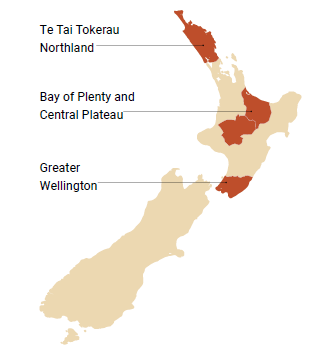
For this 2024/25 reporting period, we visited communities in the Bay of Plenty and Central Plateau, Greater Wellington and Te Tai Tokerau. These regions varied in terms of Māori population. In Te Tai Tokerau, Māori make up more than half of the youth population. In the Bay of Plenty, Māori are just under half of the youth population. In Greater Wellington, Māori make up less than a quarter of the youth population.
1 Our 2023/24 Outcomes for Māori report, published in June 2025, can be found at aroturuki.govt.nz/reports/outcomes-23-24
2 Ministerial Advisory Committee. (1988). Pūao-Te-Ata-Tū. Department of Social Welfare. msd.govt.nz/documents/about-msd-and-ourwork/publications-resources/archive/1988-puaoteatatu.pdf
3 aroturuki.govt.nz/what-we-do
4 The IDI holds de-identified data about people and households in . Results from IDI analysis are not official statistics. They have been created for research purposes from the IDI, which is carefully managed by Stats NZ. For a full disclaimer, see Appendix Two. For more information about the IDI, visit stats.govt.nz/integrated-data
5 What About Me? is the external branding of the 2021 Youth and Health Wellbeing Survey conducted by Malatest International. msd.govt.nz/about-msd-and-our-work/publications-resources/consultations/youth-health-and-wellbeing-survey-results/index.html
6 We also sent information requests for our 2024/25 reports to Te Tāhuhu o Te Mātauranga | Ministry of Education, Manatū Hauora | Ministry of Health, VOYCE – Whakarongo Mai, Office of the Ombudsman, Te Whare Kaupapa Āwhina | Open Home Foundation, Barnardos, Kōkiri Marae Keriana Olsen Trust and Whanonga Pirihimana Motuhake | Independent Police Conduct Authority. Information from some of these organisations features in our 2024/25 Experiences of Care in Aotearoa report.
7 For example, Oranga Tamariki was not able to provide information about renotification of reports of concern at different intervention phases, where and go and who cares for them after they leave the custody of Oranga Tamariki, or whether a referral for services and support has been made to a partner.
8 In the case of younger tamariki, ethnicity is usually identified by a parent or guardian on their behalf.
9 abuseincare.org.nz